The Unexpected Revolutionaries
Every Thursday evening, the back room of a Hanover community centre transforms into something between a craft circle and a support group. Around mismatched tables, twenty-odd people of all ages bend over knitting needles, crochet hooks, and embroidery hoops, their conversations flowing as freely as their stitches.
This is the Brighton Stitch Collective, and it's part of a quiet movement spreading across the city — one that's using wool, cotton, and silk to weave something more valuable than scarves or jumpers. They're stitching together community.
"I came here because I was lonely," admits Sarah Chen, a 28-year-old graphic designer who moved to Brighton during lockdown. "I stayed because I found my people." She holds up a half-finished jumper in sunset colours. "This isn't really about the knitting anymore."
 Photo: Sarah Chen, via is2-ssl.mzstatic.com
Sarah's story echoes across Brighton's growing network of textile groups. From the punk-inspired yarn-bombers decorating bus stops with crocheted cozies to the gentle souls teaching therapeutic embroidery in care homes, the city has become an unlikely epicentre for what might be called the new craft activism.
Beyond Instagram Aesthetics
Unlike the perfectly curated craft content flooding social media, Brighton's textile movement has a deliberately rough-around-the-edges quality. The Brighton Guerrilla Knitters — who prefer to remain anonymous — specialise in covering public furniture with bright, slightly wonky woollen wraps that appear overnight like textile graffiti.
"We're not trying to be perfect," explains one member, who goes by the nickname Purl. "We're trying to be human. There's something radical about making imperfect things in a world obsessed with polish."
Their work appears without fanfare: bus stop benches wrapped in rainbow stripes, park railings adorned with knitted flowers, telephone boxes sporting crocheted scarves. It's temporary art that weathers and fades, embodying a philosophy that values process over permanence.
The movement's anti-aesthetic stance extends to its participants. At any Brighton textile gathering, you'll find former corporate burnouts sitting alongside retired teachers, art students next to NHS workers on their day off. The unifying factor isn't skill level or age — it's a shared hunger for something authentic in an increasingly digital world.
The Therapy of Making
Dr. Emma Williams, a Brighton-based psychologist who studies the mental health benefits of craft activities, isn't surprised by the movement's growth. "There's something profoundly healing about repetitive hand movements combined with creative expression," she explains. "It activates the same neural pathways as meditation, but with the added benefit of creating something tangible."
The evidence appears in Brighton's textile groups daily. At the weekly 'Knit and Natter' sessions in Preston Park, participants regularly credit their craft practice with helping them through divorce, bereavement, career changes, and mental health struggles.
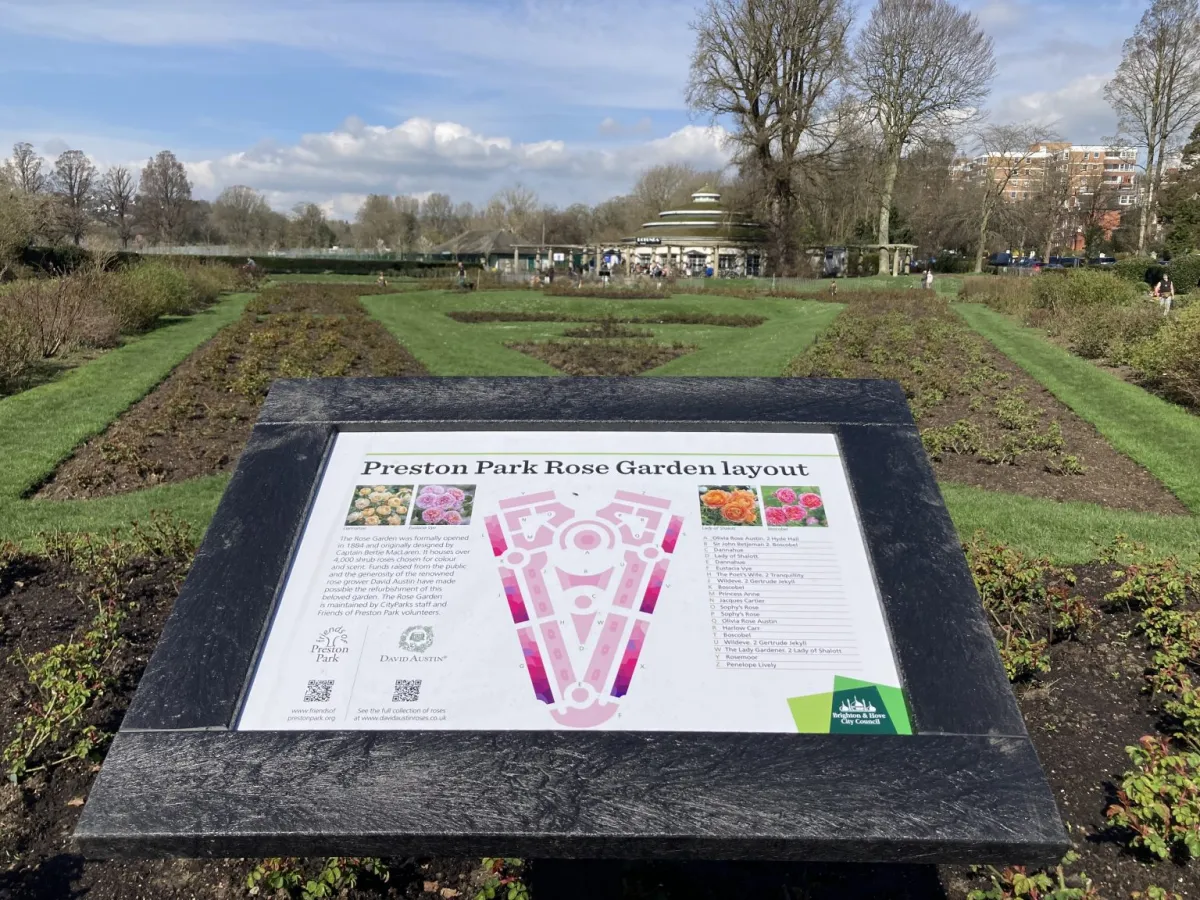 Photo: Preston Park, via www.friendsofprestonpark.org
"My hands were shaking so badly from anxiety I could barely hold a cup of tea," remembers Janet Morrison, a 45-year-old teacher who discovered knitting during a particularly difficult period. "Learning to control the needles gave me back control of my body. It sounds dramatic, but it saved me."
Janet now runs beginner workshops, teaching the same techniques that helped her heal. Her students range from teenagers struggling with exam stress to new mothers battling postnatal depression. The common thread — literally and metaphorically — is the transformative power of focused, repetitive creation.
Stitching Social Change
Beyond personal healing, Brighton's textile collectives are increasingly engaging with broader social issues. The Brighton Refugee Knitting Circle creates warm clothing for asylum seekers while providing English conversation practice for immigrant women. The Eco Stitchers specialise in visible mending workshops, teaching people to repair rather than replace damaged clothing.
"Every stitch is a small act of resistance against throwaway culture," says collective member Rosa Patel, demonstrating the Japanese art of sashiko mending on a pair of jeans. "We're not just fixing clothes — we're fixing our relationship with the things we own."
This philosophical approach extends to the materials themselves. Many Brighton textile groups emphasise sustainability: unravelling charity shop jumpers for yarn, using natural dyes made from kitchen scraps, teaching traditional techniques that prioritise durability over speed.
The movement has even spawned its own economy. Several members now sell their work at Brighton's various markets, while others teach workshops or offer repair services. It's a deliberately small-scale economy that prioritises relationships over profit.
The Digital Detox Generation
Perhaps most significantly, Brighton's textile movement attracts a surprising number of young people seeking respite from digital overwhelm. The city's various craft cafés regularly host 'phone-free' sessions where participants check their devices at the door in favour of needles and thread.
"My generation grew up thinking our phones were extensions of ourselves," reflects 22-year-old university student Alex Thompson, carefully working a complex cable pattern. "Learning to knit was like remembering I had actual hands."
Alex discovered knitting through TikTok, ironically enough, but quickly moved away from the platform's fast-paced aesthetic in favour of Brighton's more contemplative textile community. "Online, everyone's an expert after five minutes. Here, people celebrate being beginners. It's revolutionary."
Weaving the Future
As Brighton's textile movement continues growing, its impact extends far beyond the craft itself. The weekly gatherings have become informal support networks, the shared projects build genuine community connections, and the philosophy of slow, mindful creation offers an alternative to contemporary culture's relentless pace.
"We're not trying to change the world overnight," says Brighton Stitch Collective organiser Mary Davies, surveying a room full of people lost in their handiwork. "We're just trying to change it one stitch at a time."
In a city known for its bold, brash creativity, these quiet revolutionaries armed with knitting needles and crochet hooks might just be Brighton's most radical residents. They're proving that sometimes the most profound changes happen slowly, carefully, and with love stitched into every single thread.