The Last Stand at the Water's Edge
Every morning at half past eight, Derek Whitman wheels his Punch and Judy booth across the pebbles to the same spot he's occupied for thirty-seven years. The red and white striped canvas is faded now, patched in places where the sea wind has tested its resilience, but the magic inside remains undimmed. Derek is seventy-four, his hands gnarled from decades of manipulating wooden puppets, his voice hoarse from shouting "That's the way to do it!" to generations of Brighton children.
He's also one of the last.
When Derek started his pitch in 1987, Brighton's seafront bustled with traditional entertainers. Punch and Judy men worked every hundred yards of beach. Fortune tellers read palms from decorated booths. Musicians busked with accordions and fiddles. Fire-eaters and magicians competed for space and audiences. Today, Derek can count his remaining colleagues on one hand—and most of those hands belong to pensioners like himself.
"People ask me when I'm going to retire," Derek says, adjusting the booth's guy ropes against a persistent offshore breeze. "But what happens to Punch and Judy when I'm gone? Who's going to learn all this?" He gestures towards his collection of hand-carved puppets, each one a character in a tradition stretching back centuries. "You can't learn this from YouTube."
The Economics of Anachronism
The decline of traditional seaside entertainment isn't just about changing tastes—it's about economics that no longer add up. Derek's pitch costs him £45 per day in council fees, before he's earned a penny. Insurance, equipment maintenance, and transport eat into already modest takings. On a good summer day, he might collect £80 in donations. On a wet Tuesday in November, he's lucky to break even.
"The council treats us like we're some sort of relic," explains Madame Zelda—real name Margaret Foster—who's been reading palms on Brighton seafront for twenty-two years. "The fees keep going up, the regulations get more complicated, but the support disappears. They want us for the tourist brochures, but they price us out of actually being here."
Margaret operates from a small painted caravan near the Palace Pier, decorated with mystical symbols and faded celebrity endorsements. Her clientele has changed dramatically over the years—fewer families seeking novelty entertainment, more hen parties looking for Instagram content. The shift has forced her to adapt her act, playing up the theatrical elements whilst maintaining the genuine craft of palm reading she learned from her grandmother.
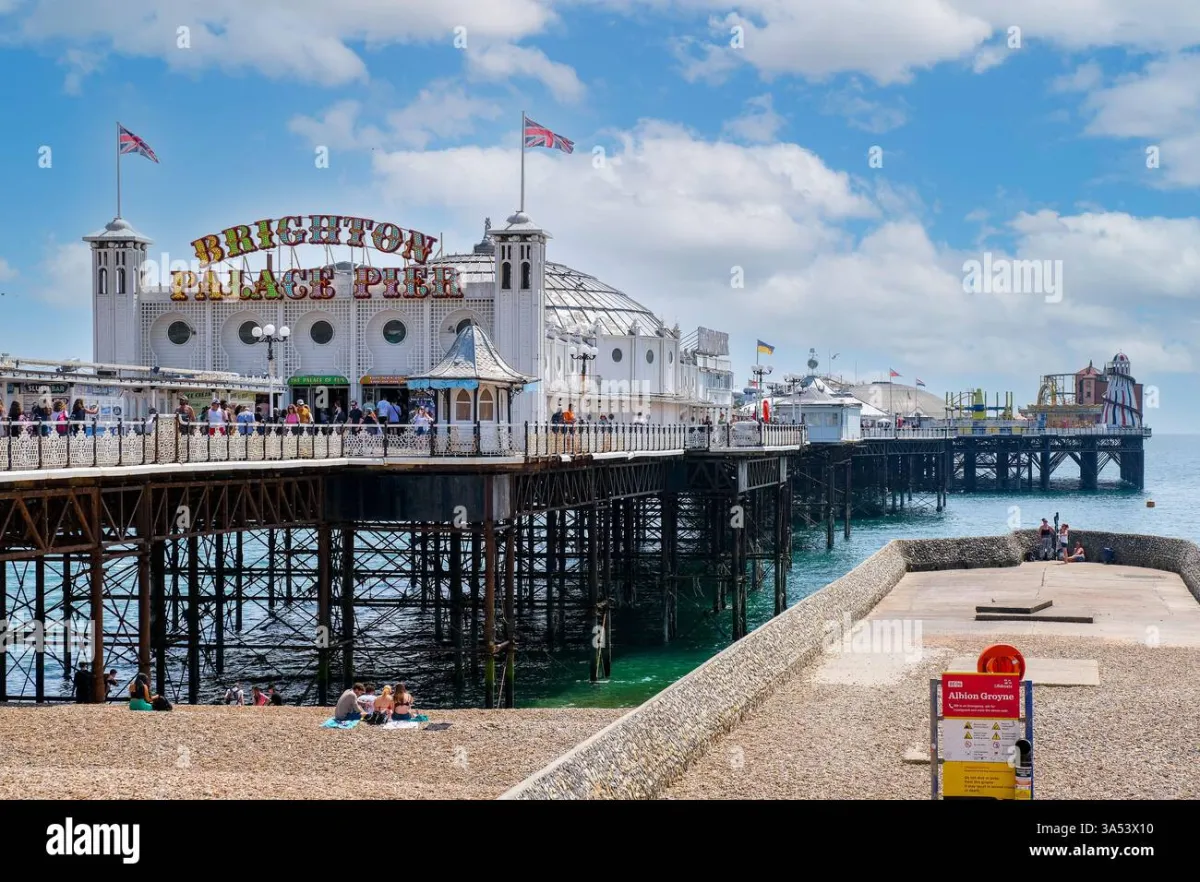 Photo: Palace Pier, via c8.alamy.com
The Digital Disruption
Modern Brighton operates on instant gratification and shareable moments. Children who might once have stood mesmerised by a Punch and Judy show now expect interactive entertainment that responds to their touch. Adults seek experiences that photograph well rather than stories that unfold slowly.
Street magician Tony Chen has felt this shift acutely. His close-up magic, which relies on intimate audience connection and sustained attention, struggles against the constant ping of phone notifications and the urge to document rather than experience.
"Magic used to be about wonder," Tony reflects, practicing sleight of hand with a worn deck of cards. "Now it's about content. People want to film the trick, post it online, move on to the next thing. But real magic happens in the moment between the setup and the reveal. You can't capture that on camera."
Tony supplements his street performances with corporate gigs and private parties, but the seafront remains his spiritual home. At sixty-one, he worries about the future of his craft and the broader culture of live, unmediated entertainment.
The Gentrification Squeeze
Brighton's transformation from working-class seaside resort to middle-class lifestyle destination has created new pressures for traditional entertainers. The seafront increasingly caters to food festivals, craft markets, and wellness events—all of which require different types of space and generate different revenue streams for the council.
"We're being squeezed out by artisan doughnut stalls and yoga classes," observes busker Jimmy Santos, who's played guitar on Brighton beach for fifteen years. "Not that there's anything wrong with those things, but there used to be room for everything. Now it feels like we're competing with a completely different economy."
Jimmy represents a newer generation of traditional entertainers—he's forty-three, university-educated, and chose busking as a lifestyle rather than falling into it by circumstance. His perspective on the changes is both sympathetic and pragmatic.
"The city's evolving, and we need to evolve with it or get left behind. But there's something valuable about maintaining these older forms of entertainment. They connect people to place in a way that's getting rarer."
The Inheritance Question
Perhaps the most pressing issue facing Brighton's traditional entertainers is the question of succession. These are skilled crafts that require years to master, yet few young people are willing to invest time learning trades with such uncertain economic prospects.
Derek's Punch and Judy booth contains puppets carved by his mentor, who learned from his mentor, in an unbroken chain stretching back to the Victorian era. Each puppet has been adjusted and refined through decades of performance, their characters honed by countless interactions with audiences. This accumulated knowledge and craftsmanship cannot be easily replaced.
"I've offered to teach people," Derek explains. "But it's not just about learning the voices and the story. You need to understand children, read crowds, handle hecklers, work in all weather. It's a whole way of life, not just a job."
The Brighton Traditional Entertainment Society, formed three years ago, attempts to document and preserve these skills. They've recorded interviews with veteran performers and created instructional videos, but acknowledge that digital preservation cannot replace lived experience.
Cultural Archaeology
What Brighton risks losing isn't just entertainment—it's a form of cultural archaeology. Traditional seaside performers carry forward not just specific skills, but entire ways of understanding public space, community interaction, and the relationship between performer and audience.
Madame Zelda's palm reading, for example, represents one of the few remaining forms of one-on-one attention that operates outside commercial therapy or consultation frameworks. Her caravan becomes a temporary confessional where strangers share hopes and fears with someone who's trained to listen and respond with both empathy and theatrical flair.
"People tell me things they wouldn't tell their families," Margaret admits. "Not because I have supernatural powers, but because I'm outside their normal world. I'm safe to talk to because I'm here today and gone tomorrow."
The Fight for Relevance
Rather than simply lamenting change, some of Brighton's traditional entertainers are actively adapting whilst preserving core elements of their crafts. Derek has introduced environmental themes into his Punch and Judy shows, with Mr. Punch now recycling and Judy promoting sustainable tourism. Tony Chen incorporates smartphone technology into his magic routines, turning digital distraction into part of the performance.
"We can't compete with theme parks or video games on their terms," Tony acknowledges. "But we offer something they can't—authentic human connection and the unpredictability of live performance. Every show is different because every audience is different."
The Value of Imperfection
In an increasingly polished and professional entertainment landscape, traditional seaside performers offer something increasingly rare—imperfection as art form. Derek's puppet shows sometimes go wrong. Margaret's predictions don't always resonate. Tony's tricks occasionally fail. But these moments of vulnerability create connection in ways that slick, rehearsed entertainment cannot.
"When things go perfectly, audiences admire your skill," Derek observes. "When things go wrong and you handle it well, they fall in love with you. That's the difference between entertainment and art."
Last Orders
As another summer season winds down, Brighton's remaining traditional entertainers face the annual question of whether to return next year. Age, economics, and changing audience expectations make each season potentially their last. Yet they persist, driven by something beyond rational calculation—a sense of guardianship for traditions that once defined British seaside culture.
"Someone needs to keep the old stories alive," Derek says, carefully packing away his puppets as the October light fades. "Not because they're better than new stories, but because they're part of who we are. When the last Punch and Judy man packs up his booth, something irreplaceable disappears forever."
The question facing Brighton—and perhaps all of modern Britain—is whether we're content to let that disappearance happen quietly, or whether we value these cultural threads enough to weave them into our evolving identity. The clock is ticking, and the tide is turning, but the final curtain hasn't fallen yet.